Bluebonnet Learning is a set of instructional materials developed by the Texas Education Agency (TEA). The materials are grounded in research, fully aligned with the Texas Essential Knowledge and Skills (TEKS), and approved by the State Board of Education (SBOE) as official curriculum resources for Texas public schools.
The Region 7 ESC Bluebonnet Curriculum team supports districts and teachers with implementation through professional learning, coaching, and collaboration.
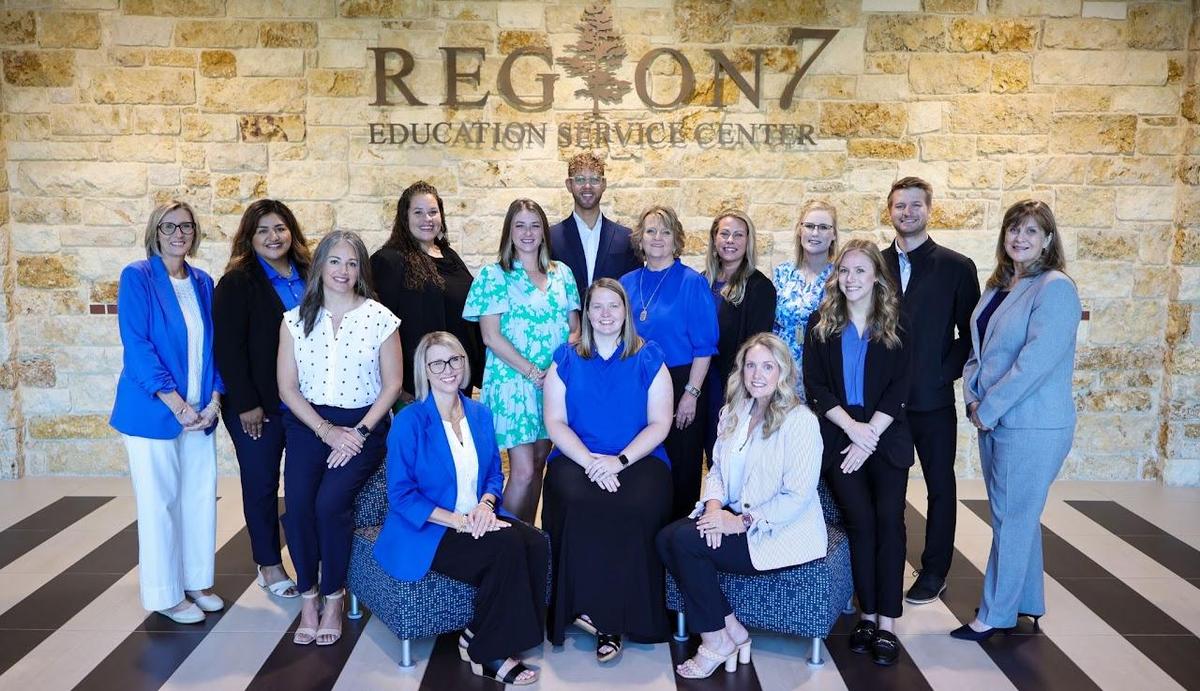
Your Region 7 ESC Bluebonnet Curriculum Team
✿ Professional Learning for Teachers
Our Bluebonnet Curriculum Specialists offer professional learning for K-5 RLA, K-5 math, and secondary math teachers in four formats:
Collectives: Four-part series where teachers meet throughout the year to plan, share, and solve problems together
Workshops: In-person sessions on timely instructional needs, held at Region 7 ESC or in your district
Virtual webinars: Online sessions with practical strategies and time to connect with other teachers
On-demand courses: Self-paced courses you can take anytime, anywhere
Choose your content area to see dates and register.
Bluebonnet RLA: K-5
Collectives, workshops, webinars, and on-demand courses for K-5 RLA teachers.
Region 7 ESC offers four implementation support options for districts and campuses. Open each option to see what's included.
A. District and Campus Leader Training For district and campus administrators
Goal: Give campus and district administrators the tools to transition to and implement Bluebonnet materials.
Location: Region 7 ESC
Includes:
Leadership Kickoff and Launch (3 days) to create the Transition Plan
Leader Communities of Practice (4 days throughout the year)
Leader Learning Walks in your district
Participation in any product training at Region 7 ESC
B. Product Training For teachers and administrators
Goal: Give teachers and administrators the tools to internalize upcoming units and lessons.
Location: Sites throughout Region 7
Includes:
Summer kickoff training (2–3 days, depending on the OERs selected)
Four meetings throughout the year for ongoing implementation protocol training
C. Coaching Support For instructional coaches, or administrators serving as instructional coaches
Goal: Give administrators and instructional coaches ongoing, monthly coaching support for successful implementation.
Location: Region 7 ESC and in your district
Includes:
Kickoff meeting
Nine face-to-face meetings throughout the year
Two Learning Walks in your district
Participation in any product training at Region 7 ESC
D. PLC Support For campus PLC leads and instructional leaders
Goal: Improve delivery of Bluebonnet Learning materials and teacher effectiveness through reflective, outcomes-oriented, research-based learning communities. PLCs build a systematic process for internalizing materials, refining instruction based on feedback, analyzing student work and data, and deepening content knowledge and research-based practices.
Includes:
Summer kickoff training (2–3 days)
Regular PLC facilitation coaching on campus to support campus PLC leads through a gradual release model
Learning Walks with the campus administrator and instructional leads
Bluebonnet Learning support for Math and/or RLA
Good to know:
IMAT funds can be used to purchase any of these supports.
You can combine supports, but leader training (A) is required. For example: A and B, A and C, or A and D.
Bluebonnet Learning materials are open educational resources, so anyone can access them digitally for free. They are designed to be printed for classroom use, and school systems can order printed copies through EMAT.
Print Pricing
Printed Bluebonnet Learning materials are available through approved vendors, including Region 4 ESC's escPrintWorks.
To be considered HQIM in Texas, instructional materials must:
Ensure full coverage of the Texas Essential Knowledge and Skills (TEKS).
Align to the English Language Proficiency Standards (ELPS) and prekindergarten guidelines.
Provide evidence-based best practices in reading language arts (RLA), math, science, and social studies.
Support all learners, including students with disabilities, emergent bilingual students, and students identified as gifted and talented.
Meet grade-level suitability requirements.
Be free from factual errors.
Enable frequent progress monitoring through embedded and aligned assessments.
Provide teacher- and student-facing lesson materials with implementation supports.
Follow the Manufacturing Standards and Specifications for Textbooks (MSST) for physical and electronic materials.
Receive approval from the SBOE through the Instructional Materials Review and Approval (IMRA) process.
Where can I find the list of approved HQIM products?
The State Board of Education (SBOE) approves instructional materials through the IMRA process, and the list is updated as publishers submit materials for review.
Open Educational Resources (OER) are free instructional materials available in the public domain or under a license that allows use, modification, and sharing. They include courses, textbooks, lesson modules, streaming videos, assessments, software, tools, and techniques that support learning.
What are the Bluebonnet Learning OER products?
Bluebonnet Learning K-5 Math
Bluebonnet Learning 6-8 Math and Algebra I
Bluebonnet Learning K-5 RLA
Bluebonnet Learning
When will Bluebonnet RLA for grades 6-12 be available?
Under the current timeline, grades 6-12 RLA will go through the IMRA process in 2029. In alignment with HB 1605, the SBOE must first approve a list of literature and vocabulary, so development of these materials is waiting until those lists are finalized.
Can Bluebonnet Learning integrate with Google Classroom or other LMS platforms?
Yes. Bluebonnet Learning is a state-developed, STAAR-aligned resource that is compatible with Google Classroom and other learning management systems (LMS).
When can districts order Bluebonnet Learning?
Bluebonnet materials are available for purchase in EMAT. Districts must have board approval before submitting orders. Ordering early is strongly recommended so printing and delivery are done in time for the school year.
Purchasing and Printing Instructional Materials
Do we have to go through a bidding process to purchase Bluebonnet Learning?
No. All vendors on the SBOE HQIM-approved list have already gone through TEA's RFP process and pricing negotiations, so a separate bidding process isn't needed.
Will print and HQIM funds cover district printing costs?
Are we required to purchase materials in bundles (for example, K-5 Math)?
No. Materials can be purchased by individual grade level (for example, only 3rd grade math). However, teacher materials (with or without manipulatives and/or trade books) and student editions must be purchased together. You cannot purchase only teacher materials or only student materials.
Can we order printed materials directly from the publisher?
No. To use HQIM and OER entitlement funds, orders must be placed through an EMAT requisition. Region 4 ESC prints all Bluebonnet products.
What training and funding resources are available in EMAT?
State-Developed OER Instructional Materials Entitlement
Does the Certification of Provision of Instructional Materials need to be completed before ordering?
Yes. You can complete the Certification of Provision of Instructional Materials in March or April. This includes an inventory of the instructional materials currently used for all courses, including CTE.
After the inventory is complete, the certification goes to your school board for approval. Once approved, it must be signed by the superintendent and school board secretary and uploaded into EMAT.
Completing this before EMAT opens in mid-May lets you start ordering right away. Accessible instructional materials can be ordered at any time.
Does the school board have to approve instructional materials?
Yes. The school board must adopt instructional materials each year, with the Certification of Provision of Instructional Materials signed by the superintendent and school board secretary.
Do districts need an OER Transition Plan?
Yes. Your district must develop an OER Transition Plan before placing any orders. Plans stay at the district level but must be available for TEA to review on request.